Operational Mechanics of the Columbus Dispatch Grid
Managing severe groundwater intrusion across Franklin County requires a highly organized telecommunications and logistics infrastructure. When high seasonal rainfall saturates the region's heavy clay strata, emergency calls peak rapidly. To manage this demand, our centralized routing network dynamically matches property owners with certified, independent local response teams positioned closest to the incident site.
This optimized distribution methodology ensures that dispatched vehicles arrive with the exact industrial extraction loadout required for the specific structural challenge. By eliminating fragmented communication loops, the system reduces response delays, helping properties mitigate catastrophic block-core saturation before structural footer joints undergo permanent hydrostatic displacement.
Advanced Equipment Loadout & Fleet Capabilities
The field managers routed through this platform operate mobile service units fully equipped with state-of-the-art structural drying and diagnostic arrays. These vehicles carry advanced digital moisture mapping sensors, high-capacity truck-mounted vacuum extraction lines, and industrial-tier LGR dehumidification plants capable of stabilizing extreme indoor environmental anomalies.
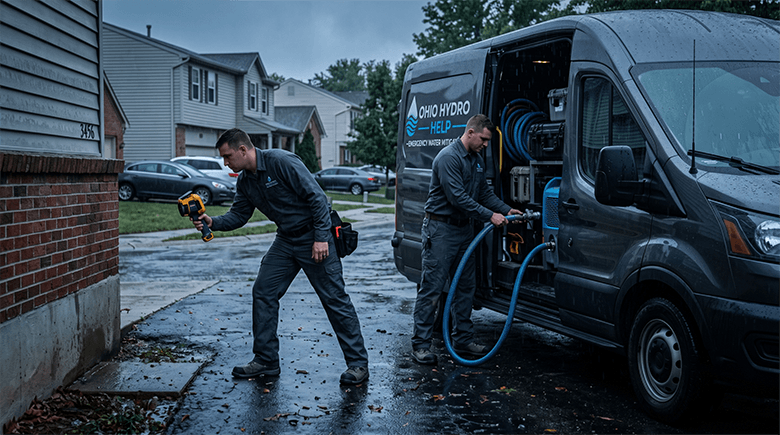 Mobilized field response units carry full structural drying complements to systematically relieve sub-floor groundwater tables.
Crews rely heavily on non-invasive diagnostic tools, using FLIR thermal cameras to map hidden moisture boundaries behind finished walls. By isolating temperature deltas caused by deep block-core evaporation, technicians can precisely execute targeted void de-watering protocols without initiating blind, destructive tear-outs of stable architectural finishes.
The Critical Role of Certified Field Technical Managers
Deploying high-velocity axial air movers and structural desiccant arrays requires extensive training in advanced psychrometric science. Field technicians must accurately compute localized environmental metrics, determining specific grains per pound (GPP) deficiencies to establish an effective vapor pressure differential. Incorrect equipment layout can cause secondary condensation damages, locking moisture inside structural boundaries.
The independent crews connected through our network possess specialized certifications in water damage mitigation and structural drying protocols. These professionals actively adjust mechanical layouts daily, monitoring drying progress charts to ensure all porous concrete elements safely return to verified regional dry standards before concluding field operations.
Rigorous Data Documentation for Insurance Property Claims
Securing full financial compensation path clearances from major national insurance providers demands immaculate, audit-ready data tracking. Adjusters closely analyze claims involving local clay soil backups, searching for reporting gaps to reduce or deny claim payouts. The independent specialists on this platform streamline this administrative burden by providing comprehensive digital property files.
These comprehensive folders compile everything from initial thermal imaging scans and equipment layout matrices to daily moisture logs and structural drying progress charts. This structured reporting format directly satisfies strict corporate insurance adjuster audit demands, removing friction and helping property owners verify structural loss values efficiently.