The Mechanics of Hollow Block Core Saturation
Standard residential concrete block foundation units are highly durable under vertical load weights, but their natural porosity makes them incredibly weak against sideways groundwater pooling. Concrete blocks are full of microscopic pores that act like sponges when exposed to persistent hydrostatic pressure. As the dense Ohio clay holds water against the outer wall, moisture slowly pushes inward.
Once the water breaks through the exterior masonry face, it flows straight down into the hollow air cavities built inside the concrete blocks. It accumulates within the hollow cores of the walls, completely saturating the lower mortar layers. Eventually, the water table inside the wall builds up high enough to breach the footer seams, streaming onto the basement floor through the slab perimeter gap and causing severe sub-floor water damage.
Advanced Structural Evacuation & Void De-Watering
Simply mopping up water or installing an interior drain tile without checking the wall cavities is a temporary patch that leads to structural breakdown. The local specialist teams routed through our database use systematic, professional de-watering protocols to completely dry out the underground masonry infrastructure. Technicians use specialized, non-invasive digital moisture mapping equipment alongside FLIR thermal imaging cameras to track hidden water levels inside block cores.
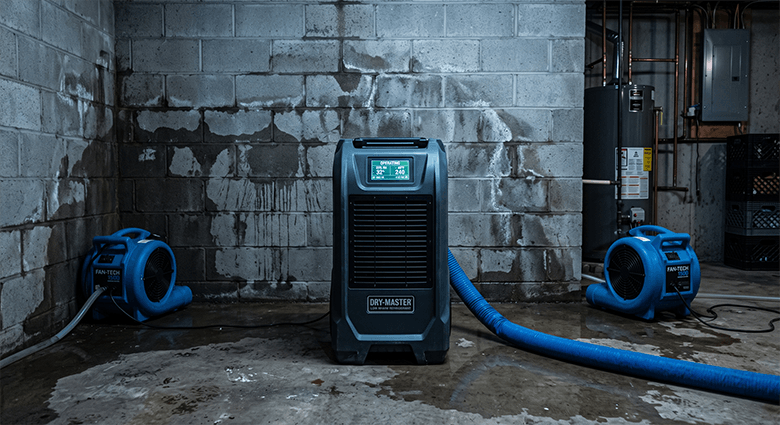 Deployment of high-capacity thermodynamic moisture extraction units to completely pull damp tracking out of porous block cavities.
These diagnostic systems capture the exact temperature changes caused by subsurface evaporation, pinpointing the boundaries of trapped water paths without tearing out undamaged materials. Once mapped, the water columns are safely targeted, evacuated, and dried using high-capacity structural equipment.
Preventing Continuous Structural Decay and Mold Colonization
Leaving hollow masonry walls wet for more than 24 to 48 hours opens the door to severe organic decay and structural rot. Saturated concrete block cores weaken the structural stability of the basement perimeter. At the same time, high humidity levels inside unventilated spaces provide an ideal breeding ground for airborne mold spores that can rapidly ruin indoor air quality throughout the home.
The independent water damage restoration crews on our database fix this using structured thermodynamic drying layouts. By setting up rows of heavy-duty commercial axial air movers paired with industrial LGR (Low-Grain Refrigerant) dehumidifiers, they pull deep moisture directly out of the concrete substrate. This comprehensive methodology protects your property values and ensures the building safely passes real estate evaluations.
Exhaustive Psychrometric Logs for Property Loss Settlements
Filing property insurance claims for groundwater backups requires absolute transparency and verifiable data logs. Corporate insurance adjusters thoroughly audit local water incidents, often denying claims if there are gaps in drying history or unverified equipment run logs. The independent professionals in our central database eliminate these risks by preparing exhaustive, court-ready digital documentation packages. Technicians utilize advanced tablet interfaces to log precise atmospheric grains per pound (GPP) and verify structural dry standards for claims adjusters.