Geological Core Metrics: Why Ohio Clay Fails to Drain
Unlike sandy loam or gravel-heavy topsoils that feature loose pore networks allowing rapid downward water filtration, central Ohio's subsoil is heavily dominated by dense glacial till and fine cohesive clay particles. The structural alignment of these clay platelets creates an almost completely impermeable barrier against natural drainage. When severe seasonal storms drop heavy rainfall over Franklin County, the water cannot settle deeply into the lower aquifer layers. Instead, it stands horizontally right around your basement walls.
This creates what civil engineers define as a localized perched water table. As additional rain falls, the volume grows, and the trapped water columns expand laterally. The expanding soil presses directly against the underground block masonry with thousands of pounds of non-stop hydrostatic force. Local plumbers who look only at basic drainage completely miss this soil-dynamic failure vector, leaving properties exposed to repetitive structural leaks.
The Capillary Action of Hollow Concrete Block Structures
Standard concrete block foundations are exceptionally durable against vertical weight loads, but their porous physical composition presents a major vulnerability to lateral groundwater pooling. Concrete contains microscopic capillary channels that act like small straws when exposed to liquid water under continuous pressure.
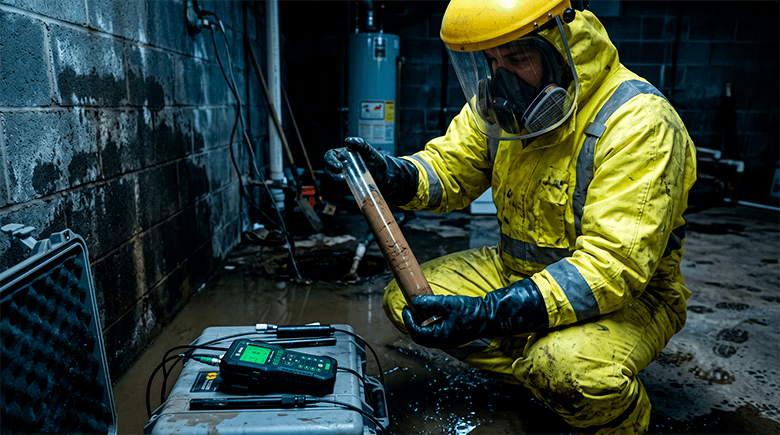 Field experts perform core density tests and water table analysis to calibrate sub-floor mechanical relief equipment.
When the water table in the external clay strata rises above the height of your interior floor slab, the water is driven straight into the outer face of the concrete blocks. It passes through the outer block shell, fills up the hollow internal air cores, and travels downwards until it hits the footer joint. Once inside, it continuously leaks out onto your basement floor surfaces, destroying finishes and driving indoor relative humidity levels into hazardous zones.
Advanced Hydrostatic Diagnostics & Volumetric Water Testing
Remediating a flooded or leaking sub-floor room requires a thorough technical understanding of local soil physics. Dispatched regional field managers do not rely on basic guesswork or surface visual checks. Crews deploy high-tech digital moisture mapping gear alongside FLIR infrared cameras to actively see through block basins and track hidden sub-slab water pathways. By measuring temperature changes caused by subsurface water evaporation, specialists map the exact layout of the water trapped behind finished drywall or beneath solid concrete floors. This non-invasive diagnostic methodology isolates hidden water tables and ensures that targeted structural drying systems can be set up efficiently.
Comprehensive Psychrometric Data Tracking for Insurance Asset Claims
Filing a property loss claim for groundwater damage through major national insurance providers requires transparent, audit-ready data. Adjusters closely scrutinize clay-soil water intrusion incidents, often denying claims or limiting payouts if there are gaps in drying records or unverified equipment run logs. The independent water mitigation specialists within our central database resolve this tracking issue by preparing complete digital documentation packages. These comprehensive folders record everything from initial thermal scans and relative humidity metrics to daily structural dry-standard charts. This structured reporting format satisfies strict provider audit demands, helping property owners secure full compensation paths.